The Best AI Native Marketers are Just Great Marketers
The channel has always been the hype. The fundamentals have never changed.
Recently I was asked how I would go about hiring an AI Native marketing team. The question motivated me to think about how every generation of marketers has faced a moment when a new channel arrives and the industry loses its mind. The language is always the same: everything has changed, the old rules no longer apply, you need people who think differently, who were born into this medium.
The channel is always presented as a paradigm shift rather than what it actually is: a new playing field on which the same human motivations play out.
We are living through one of those moments right now with AI. And if history is any guide, the companies that will win are not the ones that hire an “AI native” marketing team. They are the ones that hire exceptional marketers who happen to be incorporating AI into every aspect of a fundamentally unchanged discipline.
The television lesson
When broadcast television scaled in the 1950s and 1960s, the advertising industry did what it always does: it panicked into specialization. Suddenly there were “television creatives” who were treated as categorically different from the print people. The medium was different, it moved, it had sound, it reached living rooms. But the breakthrough campaigns of that era were not won by people who were native to the screen. They were won by people like David Ogilvy and Bill Bernbach, who had internalized something deeper: a rigorous, almost anthropological understanding of what motivates a person to act, and an instinct for how to present an idea with clarity and force.
The channel was new. The question: what does this person want, and how do I make them believe I can give it to them? was not.
The direct mail lesson
The 1980s brought another revolution. Database marketing and direct mail transformed marketing from an art of persuasion into a science of segmentation. Response rates, lists, A/B testing at scale, cost per acquisition as a north star. The dominant narrative was that a new breed of “data driven” marketer had superseded the intuitive, creative kind. Some companies hired accordingly, building teams of analysts who could optimize a mailing list but had no idea what made an offer compelling.
The direct mail marketers who actually built durable businesses never made that mistake. They understood the data as a way to be more precise about human psychology, not a replacement for it. The ability to segment was useless without a deep understanding of which segment wanted what, and why. The offer still had to be right. The story still had to land.
The social media lesson
This is the one most CMOs lived through professionally, so it deserves the most scrutiny. When social media arrived in the mid-2000s, the pressure to hire “digital natives” was intense. The conventional wisdom held that people who had grown up on these platforms had an intuitive grasp of them that older marketers could never replicate. Agencies built “social media practices.” Job descriptions appeared for “community managers” and “social strategists” who were valued primarily for their fluency with the platforms themselves.
Some of that specialization was warranted: the mechanics of Facebook’s algorithm, the culture of Twitter, the visual grammar of Instagram all genuinely required investment to understand. But watch what happened over the next fifteen years. The brands that built lasting audiences on social media were not the ones with the most platform fluent teams. They were the ones with the clearest point of view, the most consistent voice, and the deepest understanding of what their customers actually cared about. Patagonia. Nike. Basecamp. Dollar Shave Club. The channel amplified their conviction; it did not substitute for it. They avoided the trap of endlessly running on a treadmill, producing content that was perfectly native and entirely forgettable.
What this means for AI
Here is the blunt version of the argument: when you hire for an AI native marketing team, you are making the same category error that has been made at every channel inflection point.
You are mistaking fluency with the medium for mastery of the discipline.
AI is genuinely powerful. It compresses work that used to take days into hours. It enables a two-person content operation to produce at a scale that previously required a team of ten. It changes the economics of personalization, testing, and iteration in ways that are still being understood. None of this is hype. The capability shift is real.
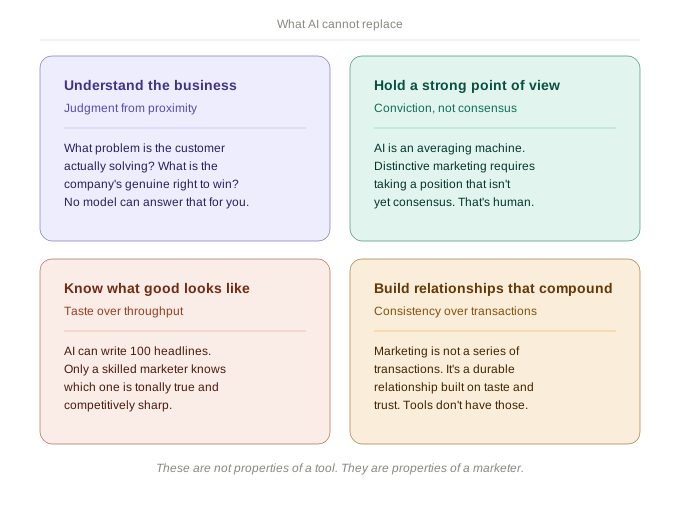
But capability is not strategy. The marketers who will use AI most effectively are not the ones who know the most prompting tricks. They are the ones who can do four things that AI currently cannot:
What to actually hire for
If the above is right, then the hiring brief for a strong marketing team in 2026 looks almost identical to what it looked like in 2006 or 1986 with one important addition.
You want people who are rigorous about understanding the customer. You want people who have developed a sense of taste who have read widely, been exposed to a lot of great marketing, and can articulate why something works.
You want people who are analytically honest, who will read results without narrative bias and change course when the data warrants it. You want people who understand the business at a level that allows them to make judgment calls, not just execute briefs. And you want people who are genuinely curious about AI as a capability, not as an identity.
That last distinction matters more than it might seem. When you are evaluating candidates, resist the temptation to weigh AI tool fluency heavily in the scorecard. Ask questions that surface the underlying judgment the role requires — and then ask, separately, how they are using AI in their current work. A strong answer sounds like: "I use it to compress the research and first-draft phase so I can spend more time on the positioning decisions that actually matter." A weak answer sounds like: "I've built a bunch of custom GPTs and I'm really deep in the tooling." The first person has a discipline; AI accelerates it. The second person has made the tool the job and without the discipline underneath, the acceleration goes nowhere.
Television didn’t change what great marketing was. It changed the cost structure of reach.
Direct mail didn’t change what great marketing was. It changed the economics of targeting.
Social media didn’t change what great marketing was. It changed the velocity and visibility of the feedback loop.
AI won’t change what great marketing is. It will change the economics of production, the speed of iteration, and the scale at which personalization is possible.
The channel is never the secret sauce. The secret sauce is the same as it has always been: a clear-eyed understanding of what the customer wants, a genuine point of view about how to meet that want, and the judgment to know the difference between content that builds something and content that just fills space.
Hire for that. The AI will follow.
About the author
Jon Louis is a marketing leader who has built brands and top performing teams across technology, healthcare, and professional services organizations.