Jevons Paradox Comes For Marketing

Jon Louis • April 21, 2026

Why falling AI token prices will make your marketing token bill bigger and what to do about it


In 1865, the economist William Stanley Jevons observed something counterintuitive about the British coal industry. Steam engines were becoming dramatically more efficient. Every new generation used less coal per unit of work. The common sense conclusion was that Britain would therefore burn less coal.


It burned far more. Cheaper, more efficient engines made coal economically viable for applications no one had previously considered. Consumption outran efficiency. Britain's coal bill went up, not down.


The same thing is happening right now to AI tokens, and most marketing leaders haven't priced it into their 2026 plans.


Three Forces

The numbers tell a simple, uncomfortable story.


Unit prices are falling fast.
Frontier model pricing has dropped 60–67% in the last twelve months. Claude Opus went from $15/$75 per million tokens to $5/$25. OpenAI's flagship dropped by a similar proportion. Gartner forecasts another 90%+ decline by 2030. Any procurement leader looking at these curves would conclude that AI is getting cheap.


Unit volumes are rising faster.
OpenAI's 2025 State of Enterprise AI report found that API token volume grew 8x year-over-year, and reasoning token consumption per organization grew 320x. Gartner estimates that agentic workflows,  the direction every vendor is pushing; consume 5x to 30x more tokens per task than a standard chatbot interaction. Deloitte's 2025 survey of 3,235 enterprise leaders found that only 7% of organizations report AI "fully scaled." If Deloitte has identified an accurate signal then ninety three percent of the consumption growth is still ahead of us.


The billing model that captures value is up for grabs.
WPP publicly told investors it is moving away from hours based pricing. McKinsey disclosed in late 2025 that roughly 25% of its global fees now come from outcome based pricing. HubSpot shifted its Breeze Customer Agent from $1.00 per conversation to $0.50 per resolved conversation. No one has figured out the right answer yet.


Stack these together and the implication is clear: falling per token prices will be swamped by rising consumption, and the revenue model that used to work, billing time, is breaking as AI efficiency increases. The winners in this environment aren't the ones with the cheapest model access. 


They're the ones who treat tokens as a managed P&L line and price their work around outcomes.


Here's how that plays out for three different kinds of marketing leaders.


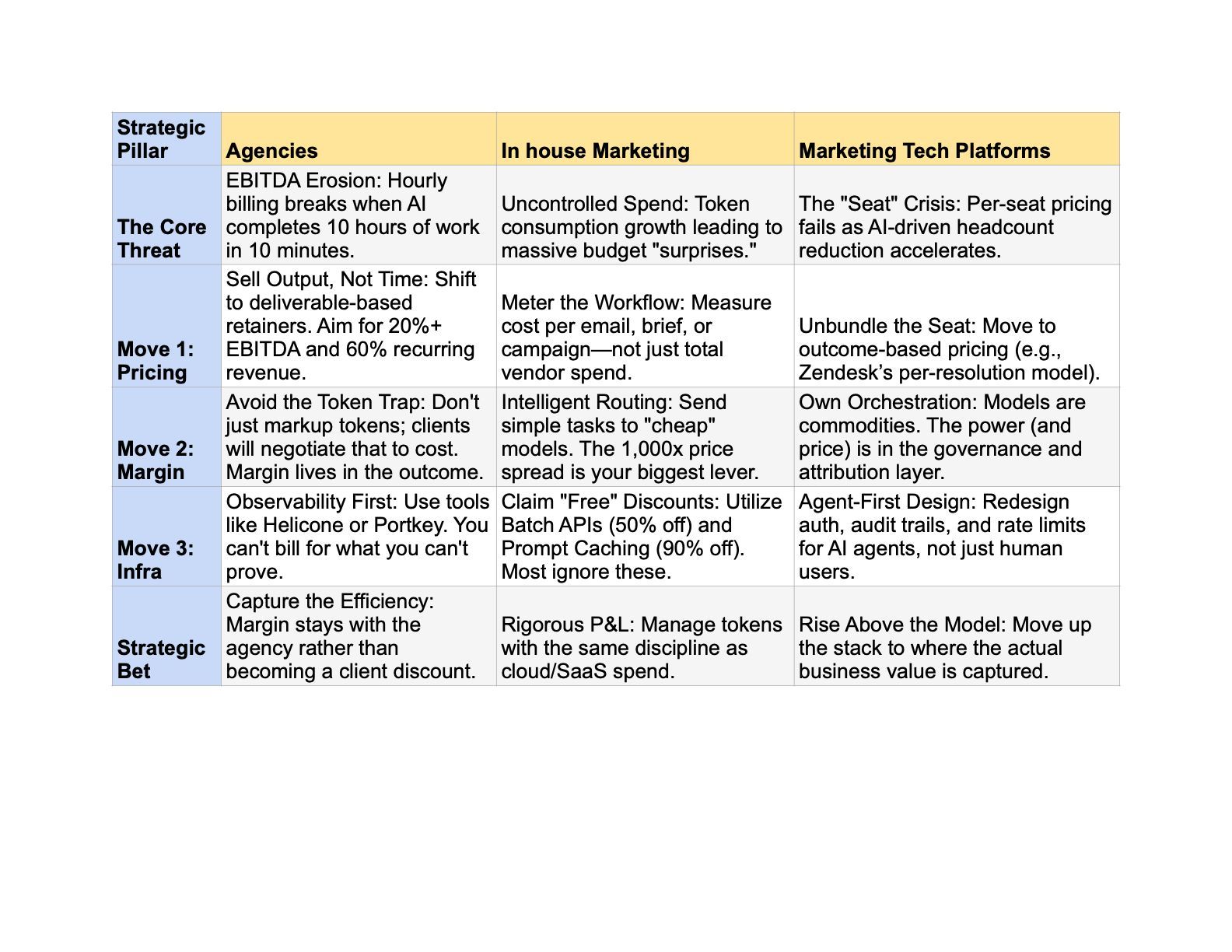
If you run an agency: your EBITDA is under active attack


The math of hourly billing breaks the moment AI shaves meaningful time off delivery. If your team can now produce a campaign in two days instead of two weeks, and you bill by the hour, your revenue just fell 80% for identical client value. SPI Research's 2025 benchmark — covering 403 professional services firms representing nearly $60 billion in revenue — found industry EBITDA fell to 9.8%, a five-year low. Utilization dropped to 68.9%, below the 75% threshold needed for healthy margins.


This is not a cyclical dip. It is the first visible effect of AI efficiency being absorbed as a revenue hit rather than a margin expansion, by agencies that haven't changed how they charge.


Three moves protect agency EBITDA in 2026:

  • Shift retainers from "hours committed" to "deliverables committed." The agencies hitting 20%+ EBITDA in the current benchmark data share a common trait: recurring revenue above 60% of total, priced to deliverables rather than staffing levels. When you deliver faster, the margin flows to you, not back to the client as a discount.
  • Stop pretending token costs are a line item. The temptation to pass through AI costs with a markup the "principal media" model applied to tokens is a trap. Clients will negotiate token pass-throughs to cost recovery within a year. Margin has to come from outcomes, not infrastructure markup.
  • Invest in the observability layer before you need it. You cannot credibly bill a client for AI-enabled work if you can't show them what was consumed on their behalf. Platforms like Helicone and Portkey, tag every API call with client, project, and campaign metadata. Agencies without this infrastructure are flying blind into client conversations that will get increasingly pointed.


If you run in house marketing at a brand: start treating tokens like cloud spend


The 2020 playbook for cloud costs now applies to AI tokens. The finance, engineering, and marketing teams that went through that transition already know what comes next: a period of uncontrolled growth, a budget surprise, a scramble for observability, and eventually the emergence of an "AI FinOps" function.


You can skip the surprise. The decisions that matter are not technical, your engineering partners handle implementation. The decisions that matter are about what you choose to meter and what you choose to automate.

  • Meter by workflow, not by tool. A CMO who knows "we spend $40,000 a month on Claude" has no actionable information. A CMO who knows "personalized email generation costs us $0.014 per email across 2.1 million sends, and our agentic campaign-brief workflow costs $0.36 per brief across 1,800 briefs" has a P&L they can optimize. Demand that level of attribution from your vendors and your internal team.
  • Match the model to the task. Most marketing work does not need a flagship model. Classification, tagging, first-draft subject lines, routine personalization, and sentiment analysis run perfectly well on Haiku, Gemini Flash, or Mistral Small at a fraction of the cost of Opus or GPT-5.4. The most expensive OpenAI model costs a 1,000× spread to the most basic.. Routing simple tasks to cheap models and reserving flagship intelligence for complex reasoning is a bigger cost lever than every caching and batching trick combined.
  • Claim the free discounts. The Anthropic Batch API offers 50% off for any workload that tolerates a 24-hour turnaround. Prompt caching on Claude cuts cached input costs by 90%. Stacked together, they yield roughly a 95% discount on workloads like overnight sentiment analysis, bulk content generation, and embedding refreshes. Most marketing teams aren't using either. This is revenue sitting on the floor.


If you run a marketing tech platform: per seat pricing is your vulnerability


In February 2026, Anthropic launched Claude Cowork. In a single trading day, the market wiped $285 billion off enterprise software valuations. By mid month the cumulative destruction reached roughly $1 trillion. Salesforce, Workday, ServiceNow, Atlassian, Adobe, and HubSpot all dropped in unison.


Goldman Sachs equity research later argued the selloff was overdone, but the underlying investor thesis is worth taking seriously: AI reduces the headcount that uses marketing software, and per-seat pricing is directly exposed to that reduction. The platforms that are adapting are doing three things at once.

  • They are unbundling their pricing. Salesforce now offers three parallel models: seats, Flex Credits at $0.10 per action, and per-user agent licenses. HubSpot shifted its AI Customer Agent to per-resolution pricing. Zendesk launched Automated Resolutions at $1.50 each. The companies winning the AI transition aren't abandoning seats: they're offering outcome-based pricing alongside seats and letting customers self select.
  • They are owning the orchestration layer, not just the model access. The model vendors (OpenAI, Anthropic, Google) are commodifying faster than anyone predicted. What isn't commodifying is the gateway, the observability, the attribution, and the governance that sits above the models. Platforms that own this layer capture pricing power regardless of which underlying model wins.
  • They are building for agents as first-class users. Your next power users aren't humans clicking through a UI,  they're AI agents calling your API on behalf of humans. The platforms that recognize this early are redesigning rate limits, authentication, audit trails, and pricing tiers around agentic access patterns. The three moves form a coherent sequence: unbundling pricing buys time, owning orchestration provides defensibility, and building for agents is where the market is actually heading.


The common thread

For all three audiences, the instruction is the same: stop treating AI as a technology investment and start treating it as a unit-economics problem.


The agencies, brands, and platforms that come out ahead in 2026 and 2027 will not be the ones with the best prompts or the most impressive demos. They will be the ones who did the boring work of instrumenting their token consumption, routing traffic intelligently, batching what can wait, caching what repeats, and most importantly pricing their output in units that survive a 90% efficiency gain.


Jevons figured this out with coal in 1865. The lesson didn't change. Cheaper inputs expand markets, and expanded markets consume more, not less. The marketing leaders who plan for rising bills despite falling prices will end 2027 with expanded margin. The ones who assume the falling prices will save them will end 2027 explaining to their boards what happened.


About the author

Jon Louis is a marketing leader who has built brands and top performing teams across technology, healthcare, and professional services organizations.


By Jon Louis April 7, 2026
The channel has always been the hype. The fundamentals have never changed. Recently I was asked how I would go about hiring an AI Native marketing team. The question motivated me to think about how every generation of marketers has faced a moment when a new channel arrives and the industry loses its mind. The language is always the same: everything has changed, the old rules no longer apply, you need people who think differently, who were born into this medium. The channel is always presented as a paradigm shift rather than what it actually is: a new playing field on which the same human motivations play out. We are living through one of those moments right now with AI. And if history is any guide, the companies that will win are not the ones that hire an “AI native” marketing team. They are the ones that hire exceptional marketers who happen to be incorporating AI into every aspect of a fundamentally unchanged discipline. The television lesson When broadcast television scaled in the 1950s and 1960s, the advertising industry did what it always does: it panicked into specialization. Suddenly there were “television creatives” who were treated as categorically different from the print people. The medium was different, it moved, it had sound, it reached living rooms. But the breakthrough campaigns of that era were not won by people who were native to the screen. They were won by people like David Ogilvy and Bill Bernbach, who had internalized something deeper: a rigorous, almost anthropological understanding of what motivates a person to act, and an instinct for how to present an idea with clarity and force. The channel was new. The question: what does this person want, and how do I make them believe I can give it to them? was not. The direct mail lesson The 1980s brought another revolution. Database marketing and direct mail transformed marketing from an art of persuasion into a science of segmentation. Response rates, lists, A/B testing at scale, cost per acquisition as a north star. The dominant narrative was that a new breed of “data driven” marketer had superseded the intuitive, creative kind. Some companies hired accordingly, building teams of analysts who could optimize a mailing list but had no idea what made an offer compelling. The direct mail marketers who actually built durable businesses never made that mistake. They understood the data as a way to be more precise about human psychology, not a replacement for it. The ability to segment was useless without a deep understanding of which segment wanted what, and why. The offer still had to be right. The story still had to land. The social media lesson This is the one most CMOs lived through professionally, so it deserves the most scrutiny. When social media arrived in the mid-2000s, the pressure to hire “digital natives” was intense. The conventional wisdom held that people who had grown up on these platforms had an intuitive grasp of them that older marketers could never replicate. Agencies built “social media practices.” Job descriptions appeared for “community managers” and “social strategists” who were valued primarily for their fluency with the platforms themselves. Some of that specialization was warranted: the mechanics of Facebook’s algorithm, the culture of Twitter, the visual grammar of Instagram all genuinely required investment to understand. But watch what happened over the next fifteen years. The brands that built lasting audiences on social media were not the ones with the most platform fluent teams. They were the ones with the clearest point of view, the most consistent voice, and the deepest understanding of what their customers actually cared about. Patagonia. Nike. Basecamp. Dollar Shave Club. The channel amplified their conviction; it did not substitute for it. They avoided the trap of endlessly running on a treadmill, producing content that was perfectly native and entirely forgettable. What this means for AI Here is the blunt version of the argument: when you hire for an AI native marketing team, you are making the same category error that has been made at every channel inflection point. You are mistaking fluency with the medium for mastery of the discipline. AI is genuinely powerful. It compresses work that used to take days into hours. It enables a two-person content operation to produce at a scale that previously required a team of ten. It changes the economics of personalization, testing, and iteration in ways that are still being understood. None of this is hype. The capability shift is real.  But capability is not strategy. The marketers who will use AI most effectively are not the ones who know the most prompting tricks. They are the ones who can do four things that AI currently cannot:
By Jon Louis March 31, 2026
AI Didn’t Break Advertising: It Just Exposed Who Forgot the Fundamentals Recently I came across a fascinating article from 1972. David Ogilvy published an advertisement that doubled as a manifesto. "How to Create Advertising That Sells" distilled everything Ogilvy & Mather learned from $1.48 billion in advertising and $4.9 million in tracking results into 38 principles. It remains one of the most cited documents in advertising history. But it got me thinking, how much of this is still relevant in the digital, AI age? Spoiler alert almost all of it!
By Jon Louis March 23, 2026
If you are a marketing leader obsessed with perfect attribution, Dark Social is your nightmare. If you are a marketing leader obsessed with revenue velocity, Dark Social is your greatest unfair advantage. In 2026, the digital landscape is fractured. As public feeds become saturated with AI generated noise, buyers have retreated. Research from early this year shows that 71% of B2B purchasing decisions are now finalized in dark channels encrypted messaging, private Slack communities, and invite-only peer circles. The Attribution Mirage Dark Social isn’t a mystery; it’s a privacy-first survival mechanism. Traditional attribution models are currently missing up to 2.7x more touchpoints than they capture because the modern buyer journey is no longer a funnel: it’s a private ecosystem. Current 2026 data indicates that 90% of the B2B buying journey is completed before a prospect ever raises their hand on your site. They are validating your claims in: Encrypted Peer to Peer: WhatsApp, Signal, and Telegram threads. The Second Office: Industry-specific Slack and Discord silos. AI Research Agents: Buyers using LLMs to synthesize vendor pros and cons before visiting a single landing page. The problem isn’t that your marketing is ineffective. The problem is that you are optimizing for the 30% of the room you can see, while ignoring the 70% of the room that actually carries the checkbook. From Volume to Validation You cannot buy your way into a private C-Suite WhatsApp group with a 30 day cookie. To win in 2026,you must shift some of your capital from Lead Generation to Trust Equity. To cultivate an Invisible Advantage, pivot to three strategic pillars: Subject Matter Authority (Not Ghostwriting): You need to stop treating your technical experts like ghostwriters for generic SEO blogs. Instead, deploy them as Architects of Influence in niche forums and private communities. When your practitioner provides a high-value solution in a private Slack without the friction of a "gated PDF" they aren't just being helpful; they are hard wiring a default preference for your brand in the rooms where decisions are actually made. Generative Engine Optimization (GEO): You must recognize that LLMs are your new "Dark" gatekeepers. Your mission is to obsessively seed your verified technical data and proprietary "Point of View" (POV) frameworks where these models train. If a buyer asks an AI agent for a vendor procurement summary, you cannot afford to be the "generic alternative" you must ensure your brand is the cited authority. Shareable Friction: In an era defined by "AI slop," your only real currency is raw authenticity. You should pivot away from over-polished whitepapers that no one reads and toward Units of Trust. These are high-impact, snackable assets, think 60second video walkthroughs of specific features, "leaked" internal ROI benchmarks, or mobile-first screenshots designed specifically for your prospects to copy paste directly into their private internal group chats.
By Jon Louis March 12, 2026
If you are a marketing professional who has spent five minutes online or on LinkedIn lately, you’ve likely seen the CMO role discussed in one of two ways: The Playbook: How to be the ultimate growth architect, AI innovator, and board-level advisor. The Obituary: Data-heavy warnings about shrinking tenures, deleted roles, and the disconnect between marketing and the rest of the C-suite. The second category often paints the CMO as an endangered species. But there is a massive epilogue missing from these tenure statistics. Where do these CMOs actually go? Contrary to the fired CMO trope, recent research from VCMO and Spencer Stuart suggests a much more empowered reality: Modern CMOs aren't just exiting; they are ascending. Whether it’s moving into a CEO role (now roughly 10% of exits), transitioning to Private Equity as an Operating Partner, or building a high-impact Fractional career, the "exit" is often a promotion by choice.
By Jon Louis February 26, 2026
#B2BMarketing #MarketingStrategy #CMO #Innovation #MarketingData #Experimentation
By Jon Louis February 24, 2026
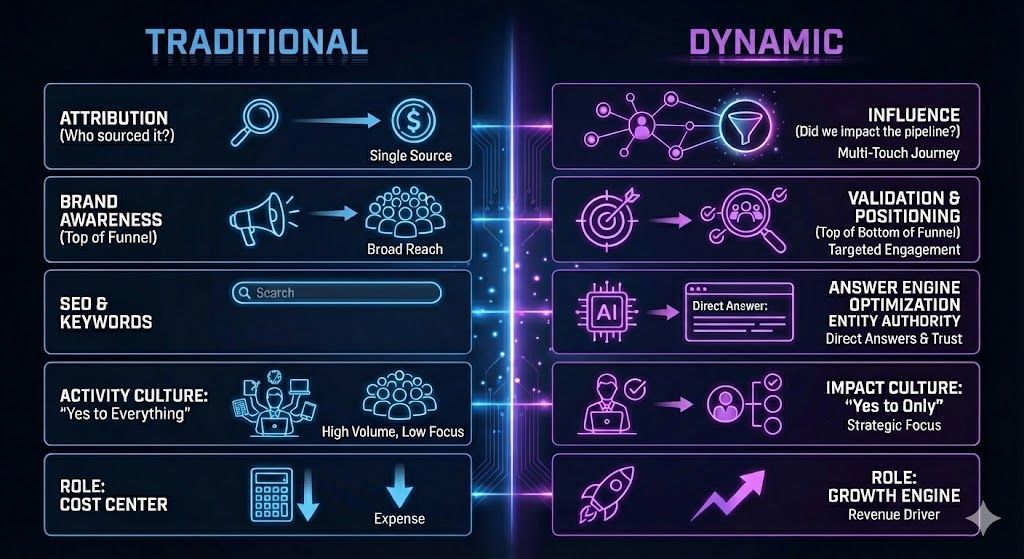
Some late winter thoughts for marketing professionals. Are you still operating with a "Traditional" mindset, focusing on single source attribution, broad reach, and treating marketing as a cost center? Or have you embraced the "Dynamic" approach, driving multi-touch influence, targeted engagement, leveraging AI for SEO, and operating as a true growth engine? IMHO The future of marketing is about: Influence over just attribution Targeted Engagement over broad brand awareness AI-driven Answer Engine Optimization over simple keywords Strategic Focus ("Yes to Only") over high-volume, low-focus activity Positioning marketing as a Revenue Driver rather than an expense It's time to adapt, innovate, and drive measurable growth. Where do you see your organization on this spectrum?
By Jon Louis February 10, 2026
The Growth Spectrum: Where Does Marketing Move the Needle? Most leaders treat marketing like a growth dial. They assume that if they turn it up, revenue will naturally follow. This is where friction with finance often comes in as well because of an expectation that revenue immediately follows investment. But many find themselves frustrated when pouring money into SEO or social ads does not result in an immediate sales spike. Usually, the problem is not the creative or the budget. It is a fundamental disconnect between their marketing tactics and their actual growth model. Scaling impact in the age of AI requires more than just better ads. It requires a Digital Thread that seamlessly connects between your marketing automation platform(s) where engagement lives and your CRM where revenue lives. Marketing’s impact is a spectrum of assistance. To get the best return, you have to know if you are building a transit system, guiding a tour, or acting as a private concierge. Marketing Dependent Growth: The Public Transit System In high volume, self serve businesses, marketing is the vessel that carries the customer from point A to point B. Because there is often no salesperson involved, there is a strong, direct correlation between marketing investment and revenue growth. In this world, your unit of trust is social proof. AI transformation here is about efficiency and identity. By using AI to validate data and resolve identities, you ensure the person clicking the ad and the person buying the subscription are recognized as the same individual. Success is a math game where AI-driven personalization fixes messaging gaps in real-time to keep the trains moving. Marketing Enabled Growth: The Guided Tour In the mid-market space, particularly B2B; marketing does not carry the customer alone. It provides the maps that make the journey possible. Here, marketing investment is an important contributor to a mix of investments that drive growth. This is also the case in a small division or a larger enterprise. Think of a product brand inside a services company or a services brand inside a product company. The Digital Thread is vital here to optimize influence. AI can predict which specific case studies or whitepapers will move a deal from "interested" to "won" based on historical efficiency. Marketing creates the qualified demand that a sales team then walks to the finish line. Without this AI driven air cover, your sales team is trying to lead people through the wilderness with no map. Sales or Relationship-Driven Growth: The Private Concierge For high-ticket enterprise contracts, the journey is exclusive and high-stakes. In this world, investments in traditional demand generation (like click-here ads) have almost zero impact on growth. Instead, investments in brand have significantly more impact. You do not find a high-end concierge through a pop-up ad. You find them through reputation. Marketing’s role here is to be the lighthouse: a signal of prestige and reliability. In an AI driven world, we no longer claim to own the lead. Instead, we use the Digital Thread to prove that we empower the journey, providing the brand authority that makes a million-dollar handshake possible.  The Bottom Line: Moving from Cost Center to Growth Engine Alignment is your secret weapon. A company trying to provide concierge-level service for a $20 app will go bankrupt from the overhead. Conversely, trying to sell a million-dollar contract with public transit marketing makes your brand look risky. Measurement is only as good as the data behind it. By connecting the Digital Thread, you move marketing from a cost center to a growth engine. Before you sign off on next quarter's budget, ask yourself: Are we running the trains, mapping the tour, or acting as the concierge?
By Jon Louis February 2, 2026
 There have been many discussions on LinkedIn and in the real world about the challenges of marketing teams that never tell their business “No”. And we have all been there! It is tough to say No. Humans are wired to say yes; we want to be seen as the hero and liked by the CEO or the Board. This challenge is also compounded now that the eager business leader who always knew they could do marketing (I mean they took the class at Sloan or Haas or Thunderbird) is now inundated with slick marketing (irony) from every LLM tool vendor about how that solution can remove layers and layers of cost while driving boundless growth.This is not a nefarious plot, business leaders are faced with a hard truth, the board only cares about proof of revenue and profitability growth; so they are trying to use the new AI tools to gain an advantage in one or both of those areas. And if the marketing team says No; the business will just use AI to get what they want and it will be just as good. (I assure you I will write about this at a future date) In this context it is very easy to build a say “ Yes to everything culture” as a way of demonstrating the value of marketing. But this is just reinforcing the incorrect meme that marketing is an order taking cost center. Even if this culture feels good; it rarely drives growth long term. And this is not just my salty take. In 2023 the Journal of Marketing coined the term the Digital Janitor Trap to highlight how a reactive Yes culture forces teams to prioritize politics over performance.
By Jon Louis January 27, 2026
Stop blaming brand awareness for missed quotas. Learn how AI-driven validation, Answer Engine Optimization, and Digital Sales Rooms solve the B2B positioning problem.
By Jon Louis January 20, 2026
Marketing leadership isn't just about math; it's about owning the growth narrative. Master the 4 questions that secure your seat at the strategic table.